


Nelson Ferreira and Paula Rego: A Historic Joint Exhibition at Lisbon's National Pantheon
Updated: Apr 18
The following is an English translation of an original interview given in Portuguese to Lígia Mourão, of Jornal Comunidades. It tells the story behind one of 2026's most eagerly awaited exhibitions — a meeting between two painters who share a classical sensibility, a love of Eça de Queirós, and a profound belief in the power of painting to reveal what words cannot. Paula Rego and Nelson Ferreira will occupy the National Pantheon in Lisbon, in a show starting on 22nd October 2026, and running until 21st February 2027.

EXCLUSIVE SPECIAL: Joint Exhibition at the National Pantheon, Nelson Ferreira and Paula Rego – the pinnacle of art!
A joint exhibition of Paula Rego and Nelson Ferreira will open on 22nd October 2026 at the National Pantheon, in Lisbon. It will be a singular moment, in which two techniques and approaches to painting will enter into dialogue. Nelson Ferreira and Paula Rego face to face, until 21st February 2027, in homage to the novel The Crime of Father Amaro by Eça de Queirós. Curated by Emília Ferreira, with the support of the Casa das Histórias Paula Rego.
Something new is about to happen in the way painting is made and experienced within the iconic space of the National Pantheon in Lisbon. Nelson Ferreira is a painter who has lived in London for more than half his life; he is Luso-British. He has come to break new ground and bring fresh ways of painting and of seeing painting.
A Vision in the Heart of Indonesia
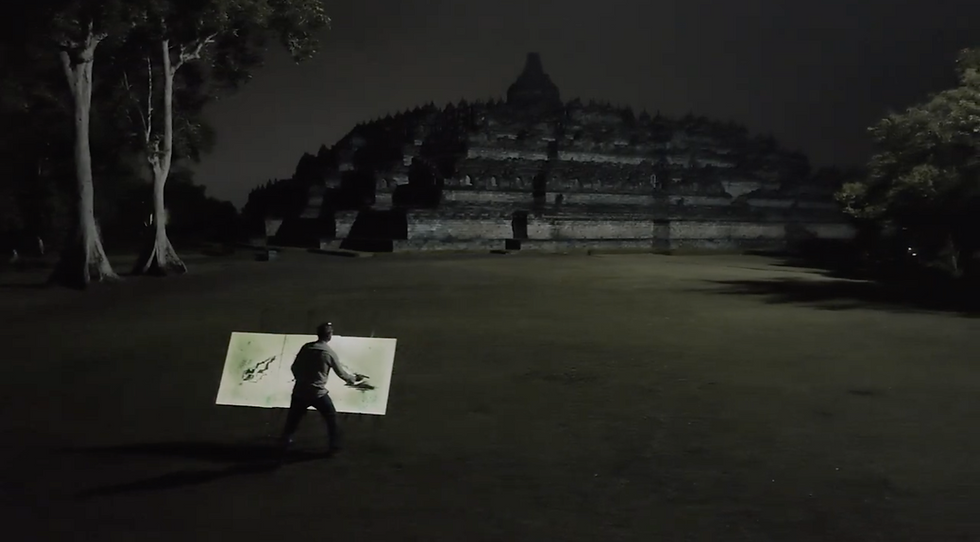
The story of the method that Nelson Ferreira will present at the Pantheon begins far from Portugal — inside the Temple of Sewu, the second largest Buddhist temple in Indonesia. It was there, in the main chamber, that something happened to the artist which is difficult to account for in rational terms.
"It was like a flash of information that came to me in a fraction of a second," he recalls. In the space of one second, perhaps one and a half, he saw around ten images at great speed — visions of silver-toned paintings of temples painted at night. He could not retain them with any clarity, but he held on to the subject matter and, above all, to the energy that emanated from them.
Upon returning to London, he would write three pages every morning of whatever came to mind, without any form of censorship: exercises from a book called The Artist's Way. When he reread those texts months later — for the aim is to write and then set it aside until it is all but forgotten — he found described there a new painting technique: one made without paint, created from platinum and secret ingredients, in which there are no pigments, yet colours and forms can be seen from certain angles, just as if paint had been applied.
He named the technique PlatiGleam — platinum that gleams. Only those who carry a light, "those who are themselves a source of light," can see the image.
Back in Portugal, without having shared the experience with anyone, Dr Joaquim Ruivo, then director of the Monastery of Batalha, proposed an exhibition at the second most visited monument in the country. Nelson accepted — and it was in preparing that show that the first paintings in the PlatiGleam technique emerged, in 2023.

The exhibition Caligem, at Batalha, received more than 127,000 visitors, making it the second most visited exhibition of the artist's career to date. From that point, invitations multiplied across UNESCO World Heritage temples around the world, from Angkor Wat in Cambodia to Nepal. Remarkably, the then director of Borobudur — the largest Buddhist temple in the world, in Indonesia — invited Nelson to paint at the Temple of Sewu itself, where the artist had first seen the visions of the paintings. All of this culminated in Nelson's major exhibition at Borobudur in 2025 — the first solo exhibition ever held in the temple's 1,200-year history.

Between Technique and Mystery
Nelson Ferreira is, above all, a painter of classical training. His touchstones are the masters of the 15th century — the Flemish Primitives, the Panels of St Vincent by Nuno Gonçalves — and French Academic painting of the 19th century. "Those are my true masters. I am always learning from the classical painting of the past," he affirms.
The PlatiGleam paintings do not represent a break with that heritage — they are rather its continuation by unexpected means. The technique, which the artist believes to be unprecedented worldwide, was first visualised within the sacred geometry of the great ancient temples. "Millenary civilisations possessed a knowledge that we have since forgotten — bound up with proportion, ornament, and space. To enter a Gothic cathedral like the Monastery of Batalha and then enter a contemporary church that resembles a municipal sports hall could not be more starkly contrasting. I believe it was also the geometry of the Temple of Sewu, with its 1,200 years of history, that inspired me."
The central conception of the exhibition at the Pantheon stems precisely from this idea: images that appear and disappear according to the angle and source of light of the observer. A visual alchemy. A transmutation between the invisible and the visible.
Paula Rego: The Greatest Narrative Painter I Have Ever Seen
For Nelson Ferreira, sharing the National Pantheon with Paula Rego is simultaneously an honour and a challenge of considerable proportions.
The two met in London, where the artist spent time with Lila Nunes — Paula Rego's long-standing model and assistant — at dinners where the painter was also present. "I learnt a great deal from Dr Paula about art. We shared many ideas in common, including a critical view of certain strands of contemporary art," he recalls.
Paula Rego was also a lover of classical painting, of drawing, of art, of the knowledge of how to draw — "a vision with which I identify and which I share." And now to exhibit at the National Pantheon alongside our greatest painter of all time — for Paula Rego was truly the Portuguese artist with the greatest international reach — is an honour without precedent.
The admiration is deep and unambiguous: "Paula Rego is the greatest narrative painter I have ever seen. No one told a story as she did." She was in all likelihood the most visited artist in the entire history of the Tate. The artist heard from British curators that the retrospective at Tate Britain, presented during the pandemic, may have surpassed 900,000 visitors — nearly double what the historic Picasso and Matisse exhibition had drawn years earlier. "It was completely sold out. In the middle of a pandemic. It is unbelievable."
Even so, Ferreira refuses the British appropriation of her legacy: "She was profoundly Portuguese. The bodies, the stories, the azulejos, the children in the street, the settings — everything points back to Portugal. To my mind, she was the most Portuguese of all painters."
The Challenge of Dialogue
The aspect that unsettles the artist most is not technical, but conceptual. His work orbits questions of optics and perception in painting; Paula Rego's is, above all, narrative. Two territories that rarely overlap.
"I will have to create a work that enters into dialogue with her paintings. Otherwise I do not think it makes sense. I believe it only works as a two-artist exhibition if that dialogue exists. And that means working in a language that does not come naturally to me," he admits, candidly.
The choice of subject unites both worlds organically: The Crime of Father Amaro by Eça de Queirós, the favourite writer of both. Rego was a devoted reader of the author of The Maias; Ferreira considers him his greatest reference in prose. The novel, with its interplay of shadow and light, power and subterfuge, body and guilt, offers a narrative structure that PlatiGleam can inhabit in an entirely new way: images that reveal themselves and conceal themselves, just as Father Amaro's secrets do.
Alchemy of Drawing

On 16th May, the première of a short film is expected to take place at the Palácio Nacional da Ajuda, filmed in the Palace itself during the pandemic. The film is directed by Leandro Valente and features Polímnia, the muse of the arts, who appears in the film. It is the story of an artist — Nelson Ferreira — who encounters the Muse of Painting — Polímnia — in the corridors of the Palace and draws her portrait using Renaissance techniques.
He begins by drawing her in silver, then in gold, and finally in platinum. "I called this film Alchemy of Drawing precisely because it is the transmutation of the baser metals into the nobler ones. And this idea of alchemy is also present in the exhibition I will be staging at the National Pantheon. The idea is, through the use of platinum — the noblest of all metals — to create luminous images that, at the same time, cannot be seen from other angles. It is an exhibition in which images appear and disappear, just as in alchemy: we will witness the sudden transmutation from the invisible and the unsayable into that which is seen and said."
A Message to Those Who Come After
Asked what advice he would leave to younger generations, Nelson Ferreira has no easy consolations to offer.
"We are not living in easy times for those who wish to elevate culture to a higher level, for those who wish to create 'civilisation'. The only message I have is: never give up." The artist, who emigrated to London in 2005, watches with unease the transformation of the city in the wake of Brexit: "It is unrecognisable — it is moribund, owing to an extreme individualism." Nelson cites a friend, the designer Jorge Moita, to explain his underlying vision: "Jorge says that we are cathedral builders. Those who began the construction never saw the finished result, for it took at least two or three generations. Everything was made for those yet to come." But the individual struggle is not enough. "The alienation of isolation is far worse than any external obstacle. My great message to younger artists is: learn to work together. It is a nearly lost art. In the visual arts, collectivist movements almost never emerge. And never give up — for the obstacles will be many, constant, and daily."
One exhibition, two painters, one monument. And a question that will linger in the air — or in the light — of the Pantheon: what do we retain in memory when an image disappears?


Comments